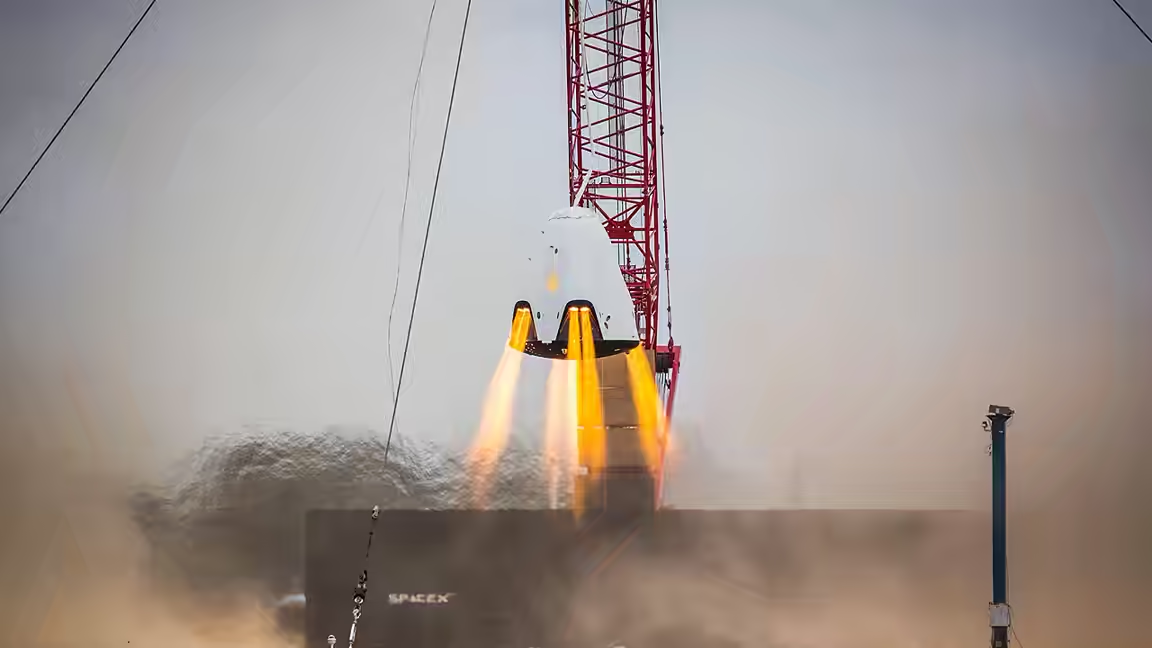
Dragon completes rapid station journey
SpaceX’s Crew-13 mission reached the International Space Station on October 1 after a journey of seven hours and 55 minutes, setting what NASA officials described as the fastest trip to the station by a US spacecraft. The Dragon capsule Grace docked after launching aboard a Falcon 9 rocket from Cape Canaveral, Florida, at 11:10 a.m. local time.
The arriving crew comprises NASA astronauts Jessica Watkins and Luke Delaney, Canadian Space Agency astronaut Joshua Kutryk and Roscosmos cosmonaut Sergey Teteryatnikov. After docking, they crossed through the pressurized connection into the station and addressed colleagues on Earth. Their expedition is expected to last about six months.
The short transit reflects the geometry required to catch an orbital destination rather than simply the speed of the launch vehicle. A spacecraft must time its departure and a series of manoeuvres to meet the station as both travel around Earth. The previous crew launched from US territory took more than 30 hours to arrive, according to AFP’s report carried by France 24.
Crew-13 had originally been expected to fly in mid-September. Its departure was delayed after a leak was found aboard the Dragon spacecraft. The successful launch and docking ended that postponement and began the handover period with the existing station residents.
Six-month handover begins
The newcomers are replacing Crew-12 members Jessica Meir, Jack Hathaway, Sophie Adenot and Andrey Fedyaev. Crew-12’s departure was expected as early as October 5, although its return remained dependent on weather conditions. Overlap between the two groups allows outgoing astronauts and cosmonauts to transfer operational knowledge before they leave.
Crew-13 also continues the uncommon area of sustained US-Russian cooperation in space. Teteryatnikov travelled alongside two Americans and a Canadian even as many other partnerships with Russia have broken down since Moscow’s 2022 invasion of Ukraine. The station programme still relies on international crews and shared operational responsibilities.
For Kutryk, the flight places another Canadian astronaut aboard the station for a long-duration mission. AFP reported that his wife is expected to give birth during his time in orbit, adding a personal milestone to a deployment already shaped by the demanding schedule of station work.
The crew arrives during the final planned years of the ISS. The laboratory has been continuously occupied for roughly a quarter of a century and is expected to be retired around 2030 through a controlled deorbit. Until then, rotating expeditions continue to operate its systems and conduct research in low Earth orbit.
The record transit is the immediate achievement of Crew-13, but the mission’s larger task begins after docking. Watkins, Delaney, Kutryk and Teteryatnikov now move from launch operations into months of station maintenance, experiments and international coordination, while Crew-12 prepares for the weather-dependent journey home.