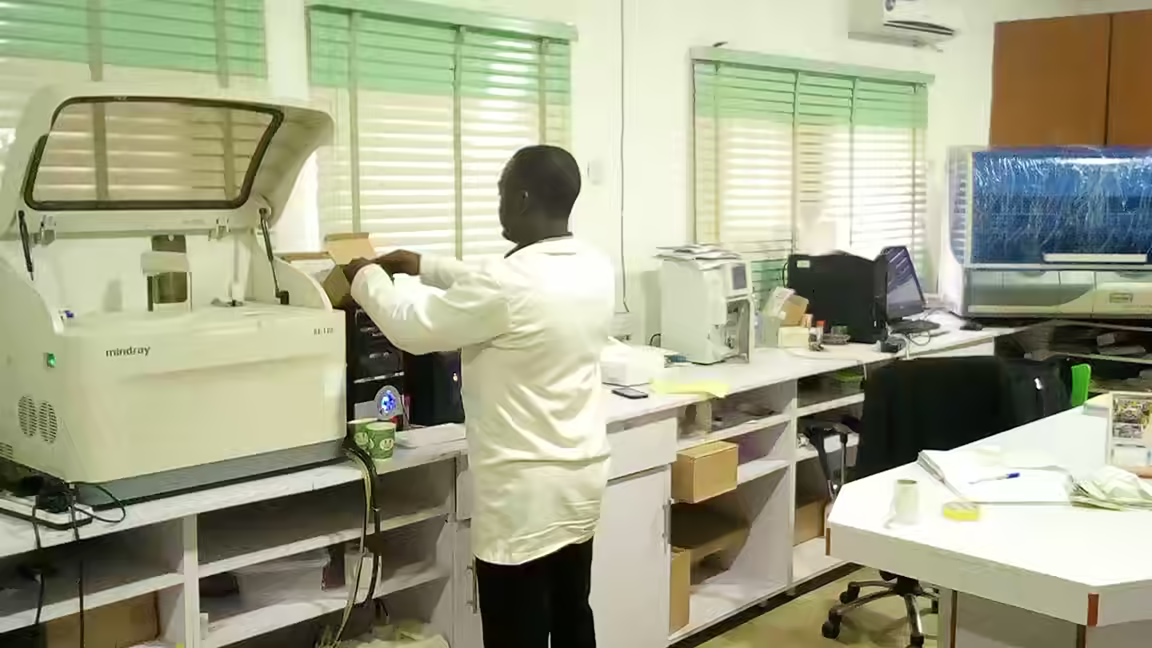
La Jolla Institute for Immunology reported unusually strong preclinical results for an experimental HIV vaccine strategy. The work remains preclinical, meaning the evidence concerns laboratory or animal-stage research rather than demonstrated protection in people.
Writer Elizabeth Tai urged newsletter authors to maintain an independent website alongside Substack. The argument centers on control over identity, archives and audience access instead of relying entirely on a single publishing platform.
Brandon Klayme served an 18-month sentence after police sought records for a one-underscore Kik username instead of the two-underscore account linked to an investigation.
A 17-checkpoint experiment gave Opus 5 the best result among three tested models, but none completed any selected challenge without accumulated defects.
A judge ruled that anti-circumvention claims cannot proceed where Google’s SearchGuard controls access to search results containing no copyright-protected material.
Kevin Baillie claims in a lawsuit that a retreat discussion of prescribed ketamine treatment became part of an investigation that preceded his dismissal.
Moonshot AI published Kimi-K3 materials through Hugging Face, giving developers a distribution point for the model and its accompanying technical information. The listing is a primary project artifact rather than an independent evaluation of capability.
Anthropic said it does not support blanket bans on open-weight AI models and described less-capable open models as a public good. It nevertheless argued for targeted measures around advanced capabilities, distillation and national-security risks.
The fire-generated storm cloud is producing shifting winds and lightning, forcing crews into a defensive strategy, a national firefighters’ spokesman said.
The htmx project promoted version 4 through a deliberately playful Game Boy-themed release. Visitors are invited to complete a small game whose presentation jokes that the JavaScript library is being distributed exclusively for Nintendo’s handheld.
A European campaign is pressing lawmakers to replace repetitive cookie pop-ups with browser-level privacy signals. Its organizers say users should be able to express tracking preferences once, while warning that advertising interests are opposing the proposal.
A technical explanation highlights how the long-standing `:` builtin can trigger parameter expansion, provide a no-operation command and simplify selected shell-script patterns.
Former Mesosphere co-founder Tobi Knaup argues that portable model weights could attract a broad tooling economy, while acknowledging important limits to the Kubernetes comparison.
A policy brief says aggregate employment data do not show an AI jobs collapse, though weaker demand for some early-career workers remains a concern requiring further study.
A developer warned that a proposed restriction on Android Debug Bridge loopback connections could disrupt Shizuku-based tools and other on-device development workflows. The report stresses that the idea appeared in an issue-tracker discussion, not a final Google announcement.
A Guardian opinion article argues that dramatic safety claims can simultaneously advertise model capability and strengthen the case for concentrated access.
A scientist’s essay asks whether bacteria marketed in a tea bag remain viable after brewing, connecting the experiment to the history of fermentation and pasteurization.
An independent firmware investigation reported a credential with administrative access to hundreds of repositories; Hanwha revoked it within 12 hours of notification.
Two configurations of Anthropic’s model share a score of 63 on version 4.1.1 of the composite benchmark, which compares 177 systems across multiple evaluations.
Anthropic launched Claude Opus 5 as a higher-performing Opus-tier model for coding, professional work and long-running agents. The company priced it at $5 per million input tokens and $25 per million output tokens and made it available across its platforms.